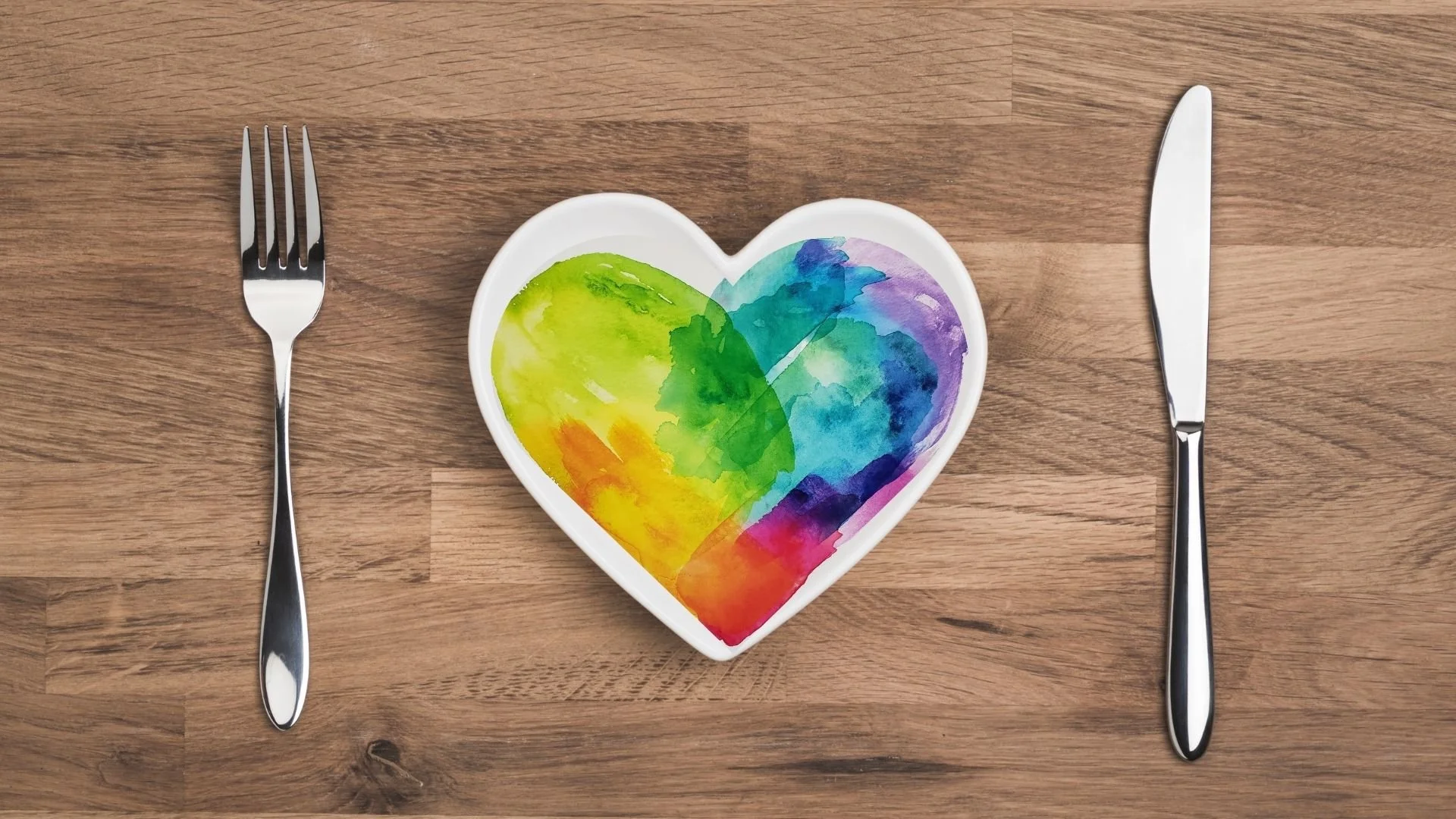
To eat like you love your body… reflect on this for a moment. To do so, you must ask yourself:
What does it mean to love and be loved?
What does loving something or someone mean to me? Does it mean to nurture, to cherish, to care for, to revere, to be devoted to, or something else?
Now, I have a couple follow up questions:
Are these currently intentions that you profess to yourself and your own body and eating?
If not, what is standing in your way of doing so?
These are good questions to ponder as you proceed through this post.
The Diet Culture Disconnection
Love is defined as “a strong feeling of affection or concern for another” yet this definition misses something of great importance… and that is that we all have the ability to not just love others, but also to love ourselves.
I think it’s likely that you’ve heard of the concept of self-love; yet too often we are unable to embody and put self-love into practice. Too many of us are in a relationship of self that is founded on dissatisfaction; dissatisfaction with our health… with our food… with our body. We turn to dieting gimmicks, rigid rules and restrictions, medical supplementation and various interventions as a way to hopefully achieve the “perfect” health, body, and relationship with food.
It’s a multi-billion dollar per year industry. Our core relationships of self have been hijacked by the limiting and demeaning principles of diet culture.
Diet culture has disconnected us from fundamentally understanding and embracing our own inner wisdom of our mind and body as our primary guide for navigating our needs in this life. As a result, we are struggling - for many, more than ever before - with chronic health issues, toxic nutritional beliefs, eating challenges, and lack of body confidence.
Yet it doesn’t have to be this way.
You may be wondering how I know this. I came into this work because of my personal journey with health, food and body challenges. I grew up with many chronic health issues including ongoing digestive distress, eating anxiety, food sensitivities, and autoimmunity in the form of Hashimoto’s Thyroiditis; all of these challenges contributed to me having a serious lack of body confidence as well as a disordered food and eating relationship. These challenges persisted and were predominant focuses of my life well into my early adulthood. These challenges are what ultimately drew me to pursue a career in nutritional therapy, herbalism, eating psychology, and functional medicine because it was through implementation of these modalities and actively practicing alignment with what my body and being were asking for, that I was able to work through and heal my chronic health challenges and empower my relationships with food and my body.
My own experiences (and those of my clients) with chronic health issues and lack of food and body confidence have sparked a deeper understanding of how nourishment truly works and manifests in life. Through this understanding I have focused my passions on furthering the nourishment of others by helping to guide them along their own journeys so they can feel embraced and empowered by their health, food and body relationships.
A significant part of this journey is discovering that, although it’s helpful to seek direction from others (like me) to help guide you on your journey, it’s rather ALL about trusting YOURSELF - and knowing how to do so.
In both my personal and professional journey with health, food and body confidence, I have found that there is a significant lack of individual understanding of self: not knowing what your core nourishment needs are, how to identify what areas are in need of support right now, how to support and implement them, how to live in harmony with your life’s purpose and passions while also manifesting abundant health AND feeling good at the same time… because that’s the goal, right? To feel good. It all gets kind of murky and muddled because these intuitive nourishments are not as highlighted or celebrated as they could be in our current society. What we are exposed to in the realm of nutrition can feel SO convoluted and confusing!
NAVIGATING INFORMATION OVERLOAD
We live in an age of constant information exposure, and as a result we are exposed to an ENORMOUS amount of nutrition information - hop on your computer, search the internet and you could spend now until forever learning, digesting, researching and debating about nutrition information - it is infinite and never ending!
So we’re not so much lacking in nutritional knowledge, but rather, nutritional wisdom. Nutritional wisdom is all about how we use this knowledge, knowing how and when to apply it in an effective way for whom at what time. And yes, there are people out there (you very well may be one of them) who are looking and needing more awareness and knowledge about nutrition approaches and how to identify fact from fallacy. Maybe this includes not knowing what foods to eat, how much proteins, fats and carbs to eat, how to cook these foods, what herbs or supplements may or may not be most helpful for the issue in question, how to meal plan or encourage ease of eating. Yes, there are a lot of people out there who are desperately seeking this information. And yet, there is another subset of people (a larger subset I may argue) who are in need of something more and different than just knowing the how-tos of nutrition facts.
Nutrition facts and information, regardless of how vitally important this knowledge is, only goes so far - and I have seen this countless times in my personal and professional nourishment practices. It is equally (dare I say more) important to understand the heart, mind and soul of who you are as an EATER as well as the circumstances that are contributing both directly and indirectly to what your body and mind are needing RIGHT NOW. Sometimes it’s necessary to reflect and reframe in order to rid yourself of all of the excess thoughts, social stigmas and habit patterns that are no longer serving you. By taking a step back, a moment to pause and a deep breath, you can relax into yourself and your relationships with your health, food, body more fully.
You have to understand the environment and context for WHY you’re wanting or needing to make nutritional or nourishment changes. You have to pause so you can ask and honestly answer the questions of:
What am I ready to change?
What am I ready to heal?
What would I find most useful to me right now?
What am I needing to get where I’m hoping to go?
These are important questions to consider.
By being able to witness and observe (without judgment) your unique needs and qualities as the beautiful individual that you are - right now in this moment - you can better understand exactly what to do for yourself and your relationship with your health, food and body.
NOURISHING Your WHOLE SELF
Since 2015, I have worked with hundreds of clients, many of whom have experienced profound shifts in their lifestyles, nutritional habits and health concerns in a variety of ways. And as I worked with more and more clients and listened to their collective stories, I began to see a common theme.
What I found was that there is much more to our healing journeys - to our stories and experiences and needs - than just needing to optimize nutrition.
The key was not just knowing WHAT to feed your body, but more importantly HOW to NOURISH your WHOLE BEING while optimizing the metabolic state and function of your body/mind. When we embrace nourishing our whole selves - in mind, body and spirit - and promote the optimal metabolic state for our bodies to best receive the nutrition we consume - we open ourselves up to a higher state of being, and we catalyze our relationships with self, health, food and body in a beautiful and transformative way.
Nutrition and Nourishment are often two words that are used interchangeably.
Nutrition is defined as “the process of nourishing or being nourished, especially the process by which a living organism assimilates food and uses it for growth and for replacement of tissues.”
In contrast, nourishment is defined as “the act of providing food or other substances necessary for life and growth.”
What we can see in these definitions is that nutrition, although a vital component of our ability to nourish ourselves, isn’t the whole story. Certainly the nutrition you take in is powerful and has the potential to nourish your body and mind in profound ways. But what we can also see is that nutrition is only a subset of nourishment. Nourishment precedes nutrition - it’s right in nourishment’s definition… to provide food or other substances necessary for life and growth… It is often these other substances that get overlooked or discounted on our journeys to better health, food and body relationships.
WHAT NOURISHES ME?
There are SO many incredible ways to nourish yourself - and this collection of things that nourish you will be unique to your own experience. Take a moment and think about something that lights you up - that makes you hum with joy and makes you feel alive. These are things that nourish you. For some, that may be creating something new, such as painting, sculpting, or cooking. For others that may be gardening, hiking, soaking in the sunshine, taking a bath, going for a walk, sipping a cup of tea, playing a game, reading a good book, redecorating, laughing with friends, learning something new…
There are so many amazing and incredibly diverse ways to nourish yourself… and a vital part of being able to address your challenges with your health, food and body is to first identify what nourishes you. One of the first things to do when beginning your journey to eating like you love your body is to ask yourself - what nourishes me? Your nourishments may include food, herbs, love, joy, beauty, laughter, family, friends, memories, art, physical and emotional pleasures…
Nourishment can be simple, elegant, complex, and nuanced. There is no right or wrong way to nourish yourself - as long as the intention behind the nourishment is nurturing (and not self-punishing or self-sacrificing). Pause for a moment to consider what your self-nourishments are:
What nourishes me? Make a list of what you find nourishing:
How can I encourage more of these nourishments in my life?
What depletes me?
How can I counterbalance these depletions with self-nourishments?
When something is truly nourishing to you, then by its very definition it must have nutritional value. Therefore nourishment PRECEDES nutrition! Because when you are nourished by something, you are able to shift into your state of calm relaxation, which optimizes your digestive and metabolic functions within your body. The very act of being in a relaxation response supercharges the nutrient-accessibility of what you eat - and therefore, your nutrition.
This is called the Parasympathetic Nervous State - and when you are in it, you are able to optimize your digestion, nutrient assimilation, burning of day-in and day-out calories, natural appetite regulation and the overall maintenance, growth, repair and healing of your body tissues.
So, in contrast, what do you think happens instead when you follow a diet or protocol that is self-punishing and stress-inducing? Is it likely that whole nourishment with calm relaxation will happen under these circumstances?
It is a sad reality that the stress-producing characteristics of diet culture actually promote and cause an INCREASE in poor (i.e. physical, emotional, mental) health producing circumstances. When you eat in a state of stress and anxiety, your physiological stress response (the Sympathetic Nervous State - you can think of this as the fight/flight/freeze/fawn response) ultimately impairs your health by promoting inflammation, dysregulating appetite, decreasing nutrient assimilation, and actually causing nutrient excretion while also down-regulating your metabolic functioning.
Understanding that what nourishes you will inherently provide a nutritional value for you as well is the space where your mind, heart, body and soul can commingle and create something new. Because your thoughts and beliefs have power - and when you are looking at a food and eating experience with thoughts and feelings of joy, contentment and pleasure, you are stimulating your state of relaxation and optimizing your metabolic fire.
So always begin by asking yourself: What nourishes me? What is a non-stressful and sustainable approach that will support my nourishment needs right now?
THE PURSUIT OF (IM)PERFECTION
What I have found in my own journey of nourishment as well as in my experiences of guiding others along their journeys, is that our challenges with our health, food and body are often pointing to a root imbalance or need that is fueling the challenge. Too often conventional approaches miss the mark when trying to address these challenges because they don’t address their root causes for why they even exist. Instead they try to mask or fight the symptom(s) of your challenge(s) and in so doing they disregard the necessity of resolving the root reasons you’re having these challenges in the first place. Don’t get me wrong - conventional approaches have their time and place and are especially helpful for acute health traumas; however, they are sorely lacking in the preventative department of day-to-day living.
Collectively we have been conditioned to FIGHT - our eating habits, our challenges with food and body, and even to fight against the body we find ourselves in - all as a way to motivate some kind of change that we think we need so that we can be better, be happier, be more lovable. Maybe that change is to be more fit, or to heal a health issue, or to have control over our appetite and the food choices we make. We are in such a constant battle with ourselves that we forget why we even began fighting (or have a need to fight) in the first place.
So why do we do this? Why are we in constant need of achieving the “perfect” body/weight/physique/health/life? Well, it’s because we’ve been taught to believe that once we’ve achieved the “perfect” this, that or the other that we’ll FINALLY be happy, healthy, and lovable - both by ourselves and others.
But here’s the thing… how can we possibly loathe ourselves into a place of self love and happiness? How can taking the path of self-loathing, mistrust and lack of self-acceptance take us to a place of whole health, self-love, and well being? Your journey and the path you take will inform your destination. You simply cannot “hate” yourself into a space of love and therefore transformation.
“The real secret to a fabulous life is to live imperfectly with great delight.”
Take a moment and reflect on the dieting and self-relationship journey that you have traveled in your personal life… have your experiences included practices of self-hate? Self attack? Rigid rules, restrictions, or deprivations that felt tedious, exhausting, and down-right unpleasant? Foods you hated and exercises you had to force yourself into doing? Were these experiences shrouded in feelings of judgment, guilt, shame, or blame when you couldn’t do it “right” or get the results you thought you were supposed to get in the timeframe you expected?
If your health, food, and body relationships have included any of these or other features of self-loathing, that is a problem. This path can only lead to a destination of disappointment and misery because your path can only reflect what is included along the way, and if your path is riddled with self-loathing features, that will be what is reflected in your destination. So the clear solution is to, instead, eat like you love your body and embrace self-compassion, kindness, and curious observation along the way.
The idea of loving your body, let alone eating as a celebration and act of love for your body, may feel profoundly confronting to you - as it is for so many of us. Maybe it feels entirely impossible or like a foreign concept that you’ve never heard of or believed to be an option for you because you have been taught for too long to fight against your body and the challenges it faces. Yet I invite you to consider that this very well may be the key to your health, food and body puzzles, and that the answer is NOT achieving the “perfect” this, that or the other, but rather relaxing into the imperfect reality of living.
The desperate search for the “perfect diet” (which is closely-related to the search for the “perfect body” and the “perfect life”) is an illusion, and such a search can only be filled with frustration, limitations, narrowness, and ultimately dissatisfaction. Because perfectionism inevitably leads to self-abuse in one form or another. Diet and nutrition do not have to be one particular thing where there is only one right or perfect way to eat or self-nourish… in reality it is much more fluid, flexible and (dare I say) simple than that.
Your issues and challenges with your health, food, and body may have little or nothing to do with food. Your issues are symbolic of something deeper. Yet your relationship with your health, food and body are GREAT TEACHERS! Your job is to listen to and learn from the lessons these relationships provide. Your unwanted health issues and eating challenges are not here to punish or victimize you or make your life miserable. Rather they are here to help you to learn, to grow and to step into your inner wisdom and power. To have more self-love, self-assurance and self-confidence.
By being receptive to the messages of your symptoms, challenges or diseases, the physical and emotional challenge or behavior will be better able to run its course and be complete. The issues you face aren’t actually the problem - they’re the solution! When you don’t listen for or hear these messages, it encourages the issue to speak up, and get a little louder, because that’s how it knows to make you pay attention. The issue is actually the cure… meaning your challenges with your health, food and body are not here to be fought against or overpowered, but rather to be deeply listened to.
DEEP LISTENING AS MINDFUL SELF-AWARENESS
Part of deep listening is the act of being conscious of the present moment. One of the most effective ways to begin eating like you love your body is to wake up and be present when you eat.
Let me explain.
If you are unconsciously eating, then part of your brain/body misses out on the experience. It doesn’t register the fact that you ate or are even eating. You miss out on the vital component of a meal’s nourishment which is receiving satisfaction and pleasure within the eating experience. If you’re body doesn’t register the fact that you ate - if you don’t fully appreciate how delectably delicious and tantalizing the meals’ tastes, textures and aromas are, let alone the physical sensation of taking food into your body - then your brain/body thinks you didn’t eat because it didn’t get the satisfaction or pleasure that it was anticipating or needing during the experience. Even though your body might be physically full, your brain is still saying, “Where’s the food? Let’s eat!”
Did you know that the mindset you have about what you’re eating can affect your appetite hormones too? Your mental projections and beliefs about what you’re eating can cause a physiological effect upon how much or little ghrelin, a key hunger hormone, is produced, which in turn encourages or discourages satisfaction with the meal.
This is why one of the foundational ways you can begin eating like you love your body is to mindfully nourish yourself and provide more consciousness to the how, what, and why of your eating.
HOW TO MINDFULLY NOURISH
The first aspect of Mindful Nourishment that I’d like to discuss is Mindful Eating and the idea that HOW we eat influences our body’s physiological ability to digest, absorb and assimilate the nutrients we’ve consumed.
Before we dive into what Mindful Eating is, I’d like you to take a moment and ask yourself the following questions:
What was the last meal that you ate?
What did it taste like?
What did it smell like?
What did it feel like?
What were you doing while eating?
What were you feeling while eating?
Now if you’re not familiar with observing your eating experiences with this degree of attention, I encourage you to follow up these questions with:
What thoughts am I having about the process of observing my eating experiences?
What feelings am I having about the observations I’m making about my eating experiences?
How do I want to behave or react to these feelings about my eating experiences?
It is immensely important to take into account HOW you eat and experience your food in addition to WHAT you eat. As humans, we can easily become distracted. These distractions can trigger the onset of eating when we’re not actually hungry, while also disrupting how we may perceive the eating experience or consequences of eating when it’s not intentional. It’s amazing how distractions can disrupt our memory of food intake. Have you ever been watching a movie and all of sudden realize your big bowl of popcorn or ice cream is gone and you didn’t even notice you were eating it? And now, guess what, you probably want more because you missed out on the experience?
This is what I like to call Mindless Eating. Mindless Eating can be triggered by a variety of environmental influences without our conscious thought or processing of whether or not we’re physically hungry at the moment. I love Brian Wansink’s quote from his book Mindless Eating - Why We Eat More Than We Think: “We overeat because of family and friends, packages and plates, names and numbers, labels and lights, colors and candles, shapes and smells, distractions and distances, cupboards and containers.” Brian is highlighting that we can be easily distracted and there are any number of influences in our food systems and culture nowadays that encourage this disconnection! The environment we find ourselves in when we eat matters, and this can easily influence how we end up eating or not eating.
When we eat under distraction, our bodies are unable to fully register that there is food intake, which results in a depressed digestive state. Let me explain this concept more thoroughly.
THE INFLUENCE OF STRESS UPON EATING
Let’s say you’re eating under stress. Maybe you’re running late for work so you’re eating in the car, or maybe you’re frantically trying to get your kids ready for school and are scarfing food while you run around the house. Or maybe you’re riddled with anxiety while trying to force feed yourself a food you find intimidating or unsafe. Whatever the stress may be, your brain and body are registering stress. When you’re eating under stress, your cerebral cortex is sending the message to shift into a sympathetic nervous state; remember, this is your fight, flight, freeze, and/or fawn response.
In these moments, your body and brain aren’t concerned with digesting your food because it perceives itself to be in a life threatening situation. Your mind and body are much more concerned with you surviving this immediate stressor. As such, your digestive juices are shut down and your blood flow is redirected away from your stomach and digestive system and toward your muscles for quick strength, dilation of your lungs and vascular systems for easier breathing and blood flow, and dilation of your eyes for maximum visibility - all as a way to keep yourself safe and have enough energy to protect yourself from the perceived life-threatening danger. All of this effectively compromises your digestive abilities because the energy needed to digest your food is elsewhere, which limits the nutrient availability of the food you are eating and it down-regulates your metabolism.
Now let’s say you’re stress starving (meaning you’re not eating because of stress). This can result in a perpetuated activation of your stress response because your cells perceive starvation, leading to stress response activation. On the otherhand, you may be more inclined to eat because of stress - maybe you lost a loved one, were fired from your job, or are feeling stressed because of an impending deadline for a project you’ve procrastinated on. Whatever the stress may be, you all of a sudden find that you are experiencing cravings which too often lead you down the road of eating for comfort; this is a frequent and common result from chronic stress. When this happens your body is more likely to hold onto any potential energy it may need to get you through this stress, which can result in abdominal weight gain, which in turn releases metabolic signaling to shut off your stress response. This works well in acute stress situations, but if your stress response is being chronically triggered by chronic stressors then this pattern often continues to repeat itself unchecked.
Knowing how the body responds to stress is important for understanding why mindful eating is so critical for your well being. Mindful Eating is not always about WHAT you eat (although that’s of course important), but rather HOW you eat.
Mindful Eating is:
Allowing yourself to become aware of the positive and nurturing opportunities that are available through food selection and preparation by respecting your own innate inner wisdom.
Using all of your senses in choosing to eat food that is both satisfying to you and nourishing to your body.
Acknowledging responses to food (likes, dislikes, or neutral feelings) without judgement, shame or blame.
Becoming aware of physical hunger and satiety cues to guide your decisions to begin and end eating.
With practice, HOW you eat influences and informs WHAT you eat.
The concept of Mindful Eating isn’t new. In fact there is an ancient Buddist meditative eating practice called “Just Enough” which originated in Japan and emphasizes mindful awareness practices by abiding to a strict order of precise movements while eating.
Horace Fletcher, who lived from 1849-1919, was an American health food enthusiast who earned the nickname “The Great Masticator” due to his theories around food which included chewing 32 times per bite, knowing where food came from, eating before being “good and hungry” and not eating while feeling sad or angry.
These are just a couple of the many examples out there of mindful eating throughout human history.
There are many elements to Mindful Eating and it can be helpful to first start with a brief overview of how this influences our physiological ability to digest the foods we are eating because this can sometimes make all the difference in how you experience your relationship with food and eating.
PARASYMPATHETIC VS SYMPATHETIC NERVOUS STATES
We have two different nervous states that primarily influence our digestion - let’s take a closer look at them both: the first is our parasympathetic nervous state (think of this as your rest, relax, digest, and calm state) and the second is our sympathetic nervous state (think fight, flight, freeze, fawn stress response). We need both of these nervous states for survival and functioning in our day-to-day living. With that being said, we have to support ourselves when we eat by being in a calm parasympathetic nervous state because this is when our bodies are most relaxed and able to allocate our energies towards digestion and our digestive organs. By being in this state when we eat, we are better able to assimilate and utilize the nutrients we consume so we can have better health, energy, and bodily functions.
Now when we’re in a stressed sympathetic nervous state, our bodies aren’t concerned with digesting our most recent meal or assimilating all of those vital nutrients. It’s much more concerned with surviving the immediate stressor that we’re experiencing (or at least perceiving) in the moment. It’s important to note that bodies aren’t able to distinguish different types of stress or stressors. I think of this as us having this big ol stress button in vibrant red and when this button gets pushed - BOOM - hello stress response! This is a survival mechanism; it is ingrained in our physiology to allocate energy to our muscles, our lungs, our eyes and our heart in order to run away from the rampaging bear (or other such life threatening threat). Now, there may not actually be a bear; maybe it’s just you getting cut off in traffic or running around the house while you’re frantically getting ready for work or believing that the food you’re about to eat is the enemy. It doesn’t matter - our bodies don’t register that it’s not a life or death situation. Instead it halts your digestive function to favor your ability to survive. Like I’ve already said, this is an important mechanism of survival, but not one that supports our ability to digest our food well when we’re eating in a heightened stress state, especially when this is happening chronically rather than acutely.
In contrast, when we’re in a parasympathetic nervous state, we are supporting what’s called the Cephalic Phase of Digestion. Cephalic simply means “of or relating to the head” so the cephalic phase response is the anticipatory reaction to food (think sight, sound, smell and texture). How often have you walked in the door after a long day and immediately start salivating when you smell that slow cooker meal that’s been stewing all day? Or the aroma of popcorn at the movie theater? Or fresh cookies being baked? These are all examples of how our senses can be stimulated and encourage the cephalic phase of digestion. This sensory stimulation prepares us to more efficiently digest, absorb and metabolize nutrients.
The ability of our bodies to anticipate food consumption and thereby produce anticipatory digestive secretions and metabolic adjustments in response to food cues are key adaptations that affect the efficiency of our digestion and metabolism. This promotes our bodies’ ability to regulate nutrients as they enter our bloodstream; if this system isn’t primed prior to and during eating, then it can result in imbalances in insulin, pH, electrolytes, and more within the blood.
The good news is that cephalic phase responses can be conditioned and mindful eating practices can directly support the reconditioning of these responses to improve your digestive function.
BITE SIZED MINDFUL EATING STRATEGIES
Here are some simple and quick bite-sized mindful eating practices that you can start using right away to help improve your nutritional self-nourishment:
Take 3 deep belly breaths before your first bite and throughout your meal as you’re able. Start with at the beginning of the meal and incorporate it as needed throughout your meal.
Say something you are grateful for before you take your first bite.
Really sense your food: take in the aromas, the visual elements, the texture of what you’re about to eat.
Identify at least one aspect of the meal before you that looks appealing.
Practice waiting to eat until you are seated and relaxed.
Count to 30 on your FIRST bite of food only, and when you’re ready you can do this more frequently throughout your meal as feels good to you.
Put your food or utensil down in between bites (this helps with pacing).
Make an observation about your food.
Have a spiritual moment before you eat.
Eat in silence or with minimal distractions.
Non-Judgmental Curious Awareness
Something you must remember when beginning this journey of eating like you love your body, is that your journey is something to be curious (not judgmental) about. When you’re curious, you are open and receptive to noticing the why of what you do… what is causing your habits and patterns to exist in the first place. When you’re curious, you are much more receptive to these reflections. But when you’re filled with judgment about these things, you end up in the blame and shame game.
Blaming or shaming yourself into action DOESN’T WORK. Blame and shame stem from a place of feeling less than and this is not a feeling we want to perpetuate. So you must identify what is causing the feelings of blame and shame (or whatever other feelings you may be experiencing) so you can reframe those thoughts in order to produce a new feeling that better serves you.
What I recommend you do as an introduction to this practice is to take - what I like to call - an empowered pause.
Take a step back and curiously observe the current experience causing you frustration. Maybe it’s emotional eating, or an inability to weight balance, or a lack of motivation to move your body or run errands or make dinner. Maybe in hearing the above Mindful Eating tips you are experiencing resistance to these practices. Whatever the situation, take a moment so you can reflect on the experience with CURIOSITY and INTEREST and COMPASSION in order to reflect on WHY you do what you do.
On that note, let’s circle back to how to eat like you love your body. I’m guessing you probably, historically, have had some beliefs or thoughts around what this means to you. Reflect on those thoughts. Are they positive and filled with possibility? Are they negative and filled with doubt and discouragement? Take a moment to assess your thoughts about what eating as an act of love for yourself and your body means to you now, and what it could mean to you as you move forward in your journey. In this space you can step into greater awareness, compassion and confidence with how you nourish yourself, your health, your eating, and your body.
What does the idea of eating as an act of self-love bring up for me?
How could eating from a place of self-compassion and love (instead of loathing) shift my experiences with food?
I encourage you to approach your wellness journey with compassion and curiosity and it’s only when you give yourself the space to do so that your truths are revealed and you can learn to trust yourself. Just notice, just pay attention. Start there and allow your relationship with yourself to flourish.
Xo
Sierra